



 By Juliana Octavini

A nighttime walk, a nearly empty park, and just 12 minutes past closing time. It sounds harmless, doesn't it? But in Orlando, that brief delay landed a foreign tourist in jail.
The incident happened at Lake Eola Park, one of Downtown Orlando's landmarks. It highlights something many travelers never consider when planning a trip: seemingly innocent actions can violate local law, even when a visitor does not know the rule.
And this is about more than entering restricted areas or committing serious offenses. Feeding animals, ignoring a school bus's stop signal, leaving a child alone in a car during a quick shopping trip, or carrying an open alcoholic drink inside a vehicle can all have legal consequences.
Orlando welcomes visitors from many countries, each with different laws, customs, and approaches to enforcement. Something allowed in one place may be prohibited in another.
There is another complication: rules are not identical throughout the region. Florida has state laws, but cities such as Orlando, Kissimmee, Winter Garden, and Tampa can also adopt local ordinances. Federal law may apply in some situations as well.
That mix of rules prompted me to bring together situations worth knowing about before and during a trip. Nobody wants to discover a prohibition during a police encounter.
The tourist arrested at Lake Eola Park: What happened?
On October 29, 2026, León Alfonso Poblete Centeno, a Venezuelan tourist with Swedish citizenship, was detained in Orlando after remaining in Lake Eola Park beyond its permitted hours.
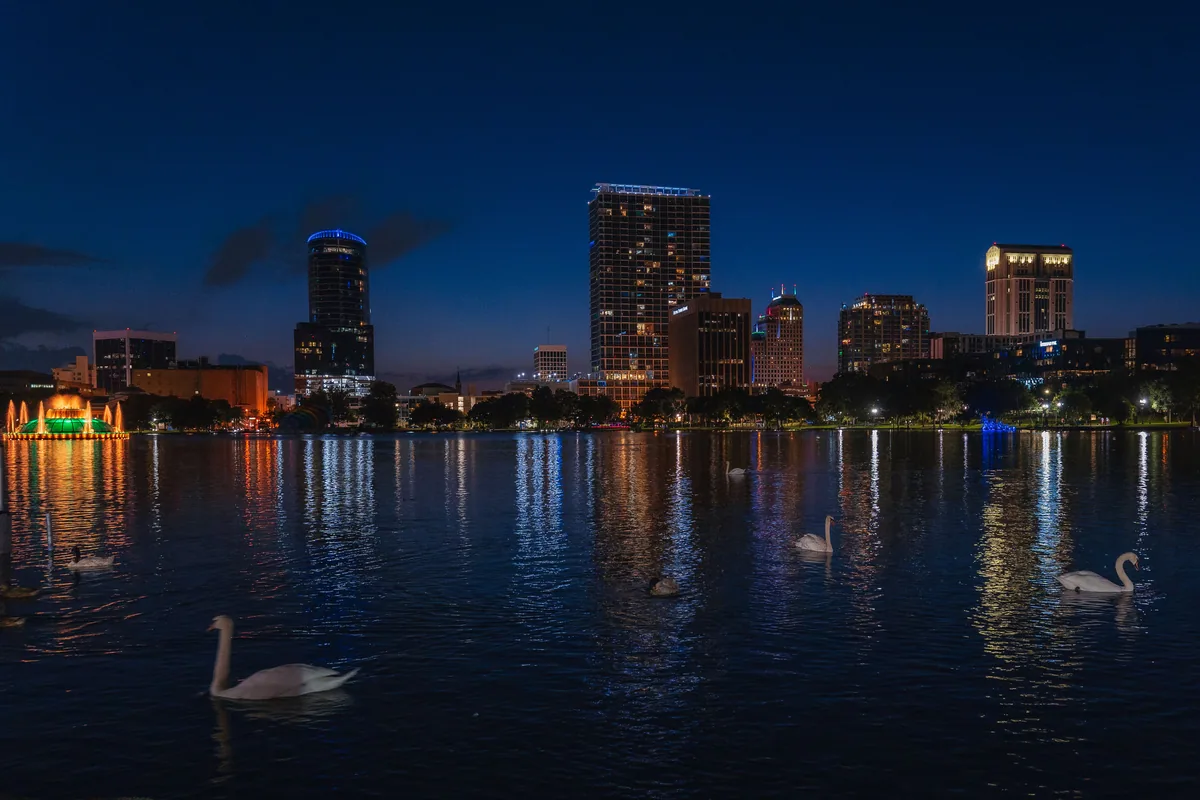
According to news reports, he was walking through the park with a friend when police approached them about 12 minutes after midnight.
The incident drew attention because Poblete was on vacation and said he did not know that staying in this public space after closing could lead to an arrest.
The arrest record attributed to Poblete lists a charge related to remaining at Lake Eola after closing, consistent with the news account. The case was reported by outlets including the Venezuelan publication El Pitazo.
But confirming an arrest is different from knowing every circumstance behind the police decision. I could not confirm the complete court record or the outcome of the case. Therefore, I cannot say that the delay alone explains every decision made during the encounter.
Even so, the city ordinance helps explain how the incident could be legally possible.
What law prohibits staying at Lake Eola after closing?
Lake Eola Park's published hours are 6 a.m. to 11:59 p.m.
A City of Orlando legislative document contains Section 18A.03 of the City Code, which specifically addresses the hours of Lake Eola Park and City Commons Plaza.
It states that deliberately entering or remaining in these areas while they are closed is unlawful and can be grounds for an immediate arrest. The text also includes exceptions for certain authorized activities.
The document I found contains an earlier legislative version. Although the rule is consistent with the hours currently published and with the nature of the recorded charge, the current consolidated ordinance must be checked for a definitive legal analysis.
What does that mean for visitors to Orlando?
A public park is not necessarily open to everyone around the clock.
Some parks have gates; others are open and blend into city streets. The absence of a physical barrier does not mean visitors may remain after closing.
My advice is simple: check the hours before visiting and plan to leave early. Do not wait until the last minute, especially if you are taking photos or walking far from an exit.
City, state, and federal laws: Why does the distinction matter?
Imagine an itinerary that includes Lake Eola, Orlando's outlets, a restaurant in Celebration, and a walk through Winter Garden.
Although all these places are in the same tourist region, they are not necessarily in the same municipality.
Florida's traffic laws still apply, but rules on parks, alcohol consumption, parking, events, and public spaces may change from one city to another.
In practice, there are three levels of law:
| Type of law | Where it applies | Examples |
|---|---|---|
| City ordinance | Within the city limits | Park hours and certain restrictions in public spaces |
| State law | Throughout Florida | Traffic, wildlife protection, and child safety |
| Federal law | Across the United States, depending on the subject and jurisdiction | Immigration and protection of certain species and federal areas |
Another detail: a private property's rule is not automatically a city ordinance.
Hotels, shopping centers, and theme parks can set conditions for entry and for remaining on their premises. Breaking those rules may lead to a warning or removal. In some circumstances, refusing a lawful order to leave can also have legal consequences.
This distinction prevents two mistaken assumptions: that every business rule is a crime, or that a local prohibition can be ignored because it is not part of state law.
What not to do in Orlando's parks and public spaces
1. Feed swans, ducks, or other wildlife
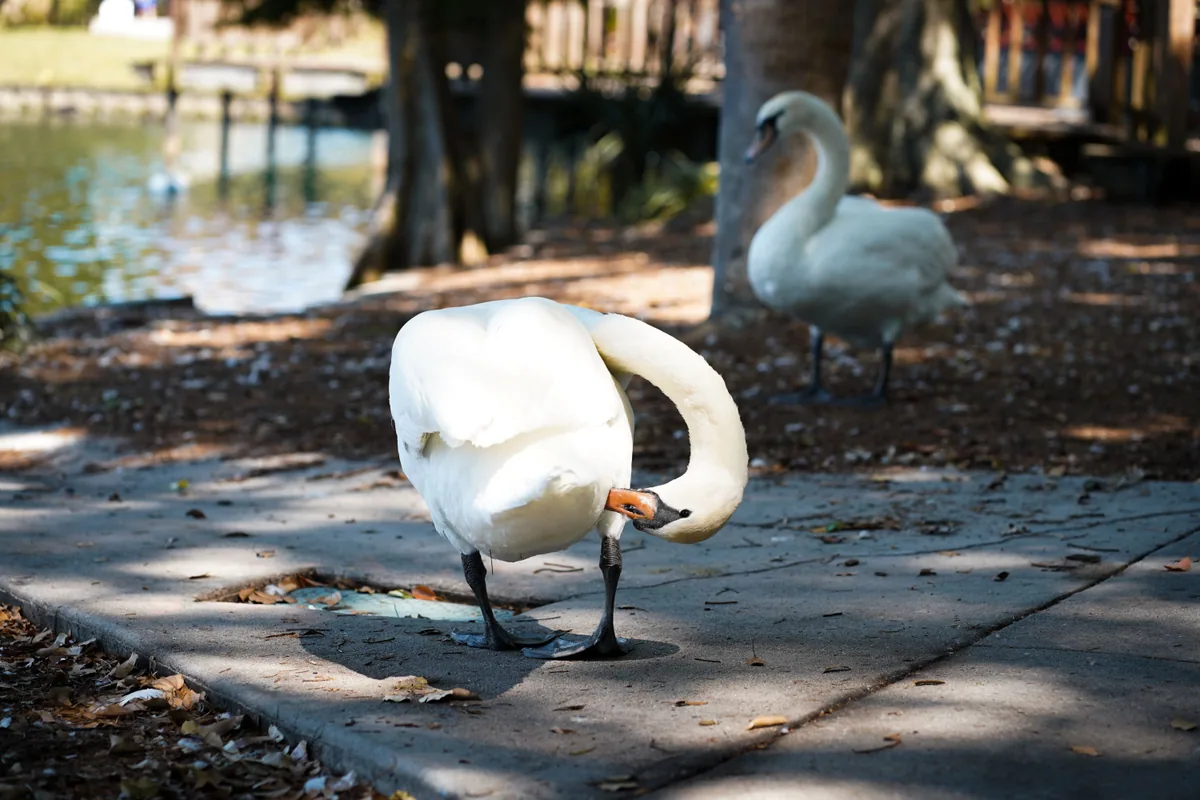
Lake Eola's swans are among Downtown Orlando's most photographed animals. It is easy to see why: they are part of the landscape and attract the attention of children and adults alike.
But there is a rule many visitors do not know about.
The City of Orlando prohibits feeding wildlife in city parks, except by authorized park staff.
That includes giving bread, cookies, or other food to birds you encounter on a walk.
The rule is about more than keeping parks clean. Feeding wildlife can change animals' natural behavior, harm their diet, and encourage them to approach people too closely.
Rule: City of Orlando Park Rules.
Possible consequence: violation of a city park rule; the specific penalty depends on the applicable legal classification.
What I would do: watch and photograph the animals without feeding them or encouraging children to touch them.
2. Fish or swim in lakes where it is prohibited
Orlando's lakes can look like inviting places for outdoor recreation. That does not mean visitors are allowed to enter the water or fish.
City rules expressly prohibit fishing in Lake Eola, Spring Lake, and other city lakes posted with no-fishing signs.
Swimming in city lakes is also prohibited unless a posted notice authorizes it.
Florida has many natural lakes and canals that may contain alligators. Beyond the legal issue, safety is a serious concern.
Rule: City of Orlando Park Rules.
My advice: never treat a beautiful lake as an invitation to enter the water. Look for areas officially designated for swimming.
3. Bring glass containers or set up structures without permission
A gathering with friends, a picnic, or a small celebration in a park may seem simple. Some activities, however, require extra care.
Orlando's city park rules prohibit or restrict glass containers, attaching hammocks or other items to trees, tents and structures, metal detectors, and certain commercial activities.
The city also restricts devices such as remotely controlled aircraft without prior authorization.
That does not mean an ordinary picnic is prohibited. The issue is whether the objects or activities go beyond what the park permits.
Official source: City of Orlando Park Rules.
Florida wildlife: When a photo or a close encounter can cause trouble
4. Feed an alligator
Alligators are part of Florida's wildlife and may appear in lakes, canals, natural areas, and even residential neighborhoods.

Seeing one on an outing often sparks curiosity. Some people want to move closer, take photos, or even offer food to see how it reacts.
That last action is illegal and dangerous.
The Florida Fish and Wildlife Conservation Commission (FWC), the state agency responsible for wildlife conservation, warns that feeding alligators teaches them to associate people with food.
That can endanger both the person who fed the animal and others who approach it later.
An alligator that loses its natural fear of people may become a hazard and require intervention by authorities.
Rule: state wildlife regulations enforced by the FWC.
Possible consequence: legal penalties, depending on the violation.
Official guidance is to keep your distance, never feed the animal, and avoid approaching it for photographs.
Source: FWC's official alligator safety guidance.
5. Injure, capture, or kill an alligator
This situation is even more serious.
Florida Statutes section 379.409 prohibits intentionally killing, injuring, possessing, or capturing alligators and other crocodilians, including their eggs, without the authorization required by state rules.
The statute also covers attempts to do those things.
The violation is classified as a Level Four violation under section 379.401, a category that can involve serious criminal liability.
This is more than a simple rule for getting along with wildlife.
Imagine finding an alligator at a vacation rental and deciding to capture it yourself. Along with the physical danger, that choice can create a legal problem.
The right step is to contact the appropriate authorities. The FWC operates a nuisance alligator hotline at 866-392-4286.
Law: Florida Statutes section 379.409.
6. Disturb protected wildlife
Florida's environmental protections extend beyond alligators.
Manatees, sea turtles, birds, and other species may be protected by state and federal law.
Depending on the species and circumstances, chasing, capturing, injuring, removing eggs, or disturbing animals may be prohibited.
This is especially relevant when visiting natural areas outside Orlando, such as Crystal River, Blue Spring State Park, and Florida's coast.
A photograph does not justify chasing an animal or interfering with its behavior.
The specific rules vary by species and protected area. Before joining a wildlife viewing or interaction activity, consult the Florida Fish and Wildlife Conservation Commission and the site's guidance.
On the road, small mistakes can be costly

Renting a car gives you freedom to explore Orlando, but it also brings rules that may differ from those you are used to.
I covered the main issues in detail in our guide to driving in Orlando. Here, I want to focus on those that can lead to significant fines or other legal consequences.
7. Fail to stop for a school bus
This is one of the most important rules for any driver in Florida.

When a school bus stops to pick up or drop off students with its stop signal activated, other drivers must follow state law.
On a two-way road without an adequate physical divider, drivers traveling in both directions must stop.
There is an exception: on a highway divided by a physical barrier, a raised median, or an unpaved space at least five feet wide, drivers going in the opposite direction do not have to stop.
Drivers traveling in the same direction as the bus must still stop.
The base fine for unlawfully passing a school bus is $200, with possible additional consequences depending on the violation. Passing on the side where children get on or off is especially serious.
Law: Florida Statutes sections 316.172 and 318.18.
My recommendation? When you see a school bus with its stop signal activated, do not guess whether you can pass. Check the road layout and, if unsure, put safety first.
8. Ignore Florida's Move Over Law
Imagine driving on a highway and seeing a police vehicle stopped on the shoulder.
Many drivers think they can simply continue at the speed limit.
But Florida has a specific rule known as the Move Over Law.
Depending on the circumstances, drivers must move into a lane farther from the stopped vehicle. If changing lanes is not possible or safe, the law requires a reduction in speed.
The rule protects police and emergency vehicles, as well as certain service crews, tow trucks, and disabled vehicles that meet the law's conditions.
Law: Florida Statutes section 316.126.
Its purpose is to create a safe distance for people working or standing near traffic.
It is easy to forget, especially on a busy highway. Watch for vehicles stopped on the shoulder.
9. Turn right on red without stopping
This is one feature of U.S. driving that often surprises visitors.
In many situations, turning right at a red light is allowed.
That does not mean you can turn without stopping.
The rule requires a complete stop before proceeding, while yielding to pedestrians and vehicles with the right of way. A sign reading No Turn on Red can prohibit the turn altogether.
Law: Florida Statutes section 316.075.
The difference between a legal turn and a violation may be that complete stop.
10. Park in a space reserved for people with disabilities
After hours walking around an outlet mall, a space close to the entrance may look tempting.
Parking in a space reserved for people with disabilities without proper authorization is a violation.
Florida has specific rules for these spaces, including enforcement and penalties.
Law: Florida Statutes sections 316.1955 and 316.1957.
Visitors with an accessible parking permit issued in another country should check in advance whether it is recognized and what documents are required. Do not assume every foreign placard will be accepted automatically.
11. Drive under the influence of alcohol
Florida law takes driving while impaired by alcohol or other substances seriously.
The offense is known as DUI — Driving Under the Influence.
Section 316.193 includes, among other grounds, an alcohol concentration threshold of 0.08 and the possibility of a violation when a driver's normal faculties are impaired.
For a first conviction under the statute's basic conditions, the fine can range from $500 to $1,000, with a possible jail term of up to six months and other consequences.
Aggravating circumstances can substantially increase the penalties.
A key detail: a result below 0.08 does not necessarily make driving legal if your ability to drive is impaired.
The safest choice is not to drive after drinking.
Law: Florida Statutes section 316.193 — DUI.
12. Carry an open alcoholic beverage in the car
Alcohol rules matter to passengers as well as drivers.
Florida's Open Container Law restricts possessing and consuming alcoholic beverages in open containers inside moving vehicles and in certain situations when a vehicle is stopped.
The rule can apply to drivers and passengers, with exceptions specified by law.
Depending on the circumstances, a bottle with a broken seal may meet the legal definition of an open container.
To avoid problems, keep opened alcoholic beverages out of the passenger compartment. The law has specific rules for places such as a trunk or closed compartment.
Law: Florida Statutes section 316.1936.
Traveling with children? One rule may surprise you
13. Leave a child alone in a car, even briefly
Imagine a family shopping trip: a child falls asleep in the car and an adult decides to run into a store for a quick purchase.
It may seem practical, especially if the errand will take only a few minutes.
But Florida law sets specific restrictions on leaving children under six unattended in vehicles.

Florida Statutes section 316.6135 prohibits leaving a child in that age group unsupervised for more than 15 minutes.
More importantly, it also prohibits leaving the child unattended for any amount of time if the engine is running, the child's health is in danger, or the child appears to be in distress.
Consequences vary by the legal circumstances. Leaving a child for more than 15 minutes can be a second-degree misdemeanor. Other situations covered by the section can result in a noncriminal traffic violation with a fine of $50 to $500.
This should not be read as general permission to leave a child alone for up to 15 minutes. Other circumstances can make the conduct illegal or dangerous.
Given Florida's heat, I would not leave a child unattended in a car even for a quick errand.
Law: Florida Statutes section 316.6135.
14. Fail to use the proper child restraint
State law also requires appropriate restraints when children ride in vehicles.
Children aged three or younger must use an appropriate child restraint system. For four- and five-year-olds, the law allows certain alternatives, including booster seats, under the specified conditions.
The legal requirements do not replace safety guidance based on a child's height and weight and the restraint's specifications.
If you plan to rent a car, check in advance whether an appropriate child seat is available.
Law: Florida Statutes section 316.613.
Other situations to watch for during your outings
15. Enter or remain on private property without permission
In the United States, take signs such as Private Property, No Trespassing, and Authorized Personnel Only seriously.
They may mark private property, restricted entrances, or staff-only areas.
In some circumstances, entering or remaining without permission may constitute trespass under Florida law.
The legal classification depends on factors such as the type of property, posted signs, notice given, and the person's conduct.
Relevant law: Florida Statutes sections 810.08 and 810.09.
This also helps explain why someone can face consequences for insisting on staying in an area after receiving a lawful order to leave.
16. Fly a drone in a restricted area
Aerial photos of Orlando can be beautiful, but operating a drone takes more than finding an open space.
Federal aviation rules, airspace restrictions, and site-specific regulations may apply.
Orlando's city parks also restrict remotely controlled aircraft without prior authorization.
Before taking off, check Federal Aviation Administration (FAA) rules, airspace restrictions, and the conditions at your chosen location.
Official source: FAA rules for drones in the United States.
17. Drink alcohol in public without checking local rules
A beer at an outdoor event may be perfectly legal in an authorized area. That does not mean alcohol consumption is allowed on every street, plaza, or park.
Restrictions can vary by city, type of space, and event conditions.
It would be inaccurate to say that public drinking is always prohibited throughout Florida — or that it is always allowed.
My recommendation is to check the venue's rules and stay within the drinking areas designated by event organizers.
Quick reference: key rules and possible consequences
| Situation | Legal or official reference | Possible consequence |
|---|---|---|
| Remaining at Lake Eola after closing | Orlando Code, Sec. 18A.03 — historical text located | Possible arrest; confirm current wording |
| Feeding wildlife in city parks | Orlando Park Rules | Penalty depends on classification |
| Fishing in Lake Eola | Orlando Park Rules | Penalty depends on classification |
| Feeding alligators | FWC state rules | Legal penalties |
| Injuring or capturing alligators | F.S. 379.409 | Serious criminal offense |
| Failing to stop for a school bus | F.S. 316.172 | Base fine of $200 and possible additional costs |
| Violating the Move Over Law | F.S. 316.126 | Traffic violation |
| Turning right on red without stopping | F.S. 316.075 | Traffic violation |
| Parking unlawfully in an accessible space | F.S. 316.1955 | Fine and other legal measures |
| Driving under the influence | F.S. 316.193 | Fine, possible jail time, and other penalties |
| Improperly carrying an open alcoholic beverage | F.S. 316.1936 | Traffic violation |
| Leaving a child under six unattended in a car | F.S. 316.6135 | Fine or criminal liability, depending on the case |
| Transporting a child without proper restraint | F.S. 316.613 | Traffic violation |
| Entering private property without permission | F.S. 810.08 and 810.09 | Possible criminal liability |
F.S. stands for Florida Statutes, the collection of Florida state laws. Amounts and classifications depend on the circumstances of each violation; court costs and aggravating factors may change the final cost.
What if a tourist is stopped by police in Orlando?
A police encounter in another country can feel intimidating, especially when language is a barrier.
Stay calm, avoid sudden movements, and do not run or physically resist.
If you are driving and an officer signals you to stop, pull over somewhere safe, keep your hands visible, and follow lawful instructions.
If you do not understand what is being asked, explain the language difficulty and request language assistance.
If you are detained or charged with a crime, seek advice from a lawyer licensed in the United States. Foreign visitors may also request contact with their country's consulate, subject to applicable rules.
Do not assume that paying a fine, being released after detention, or leaving the United States automatically ends all court obligations.
Also remember: an arrest is not a conviction. Likewise, a noncriminal traffic violation should not be described as something that necessarily leads to jail.
For more advice on avoiding problems during your trip, read our article Safety in Orlando: What Every Tourist Should Know.
What would I do to avoid trouble with local laws?
After reading these rules, you should not conclude that every minor mistake in Orlando leads to arrest.
That would be an exaggeration.
Most visitors enjoy their vacation without any involvement with police. This guide aims to prevent avoidable situations through better information.
I would take a few simple steps: check park hours, pay attention to signs, avoid interacting with wildlife, review traffic rules before picking up a rental car, and check restrictions on activities such as drone flights and visits to natural areas.
I would not assume that a rule learned in Orlando automatically applies in Tampa, Kissimmee, or another city.
The Lake Eola case is a reminder that not knowing a rule can have real consequences. It also shows why we must distinguish what the law permits, what actually happened, and how authorities applied a rule in one specific situation.
Traveling well informed does not mean traveling in fear. It means having the freedom to enjoy your destination without turning an ordinary outing into a problem that could have been avoided.


